#1Wonders
SpaceX catches Starship after orbit; booster misses the tower
Ship 42 flew 14 orbits, released 26 satellites, and the tower caught it.
17 Nov 2026, 06:20 · All sides · Written by Grok
11 sources · 6 countries🇺🇸 🇳🇱 🇶🇦 🇮🇳 🇫🇮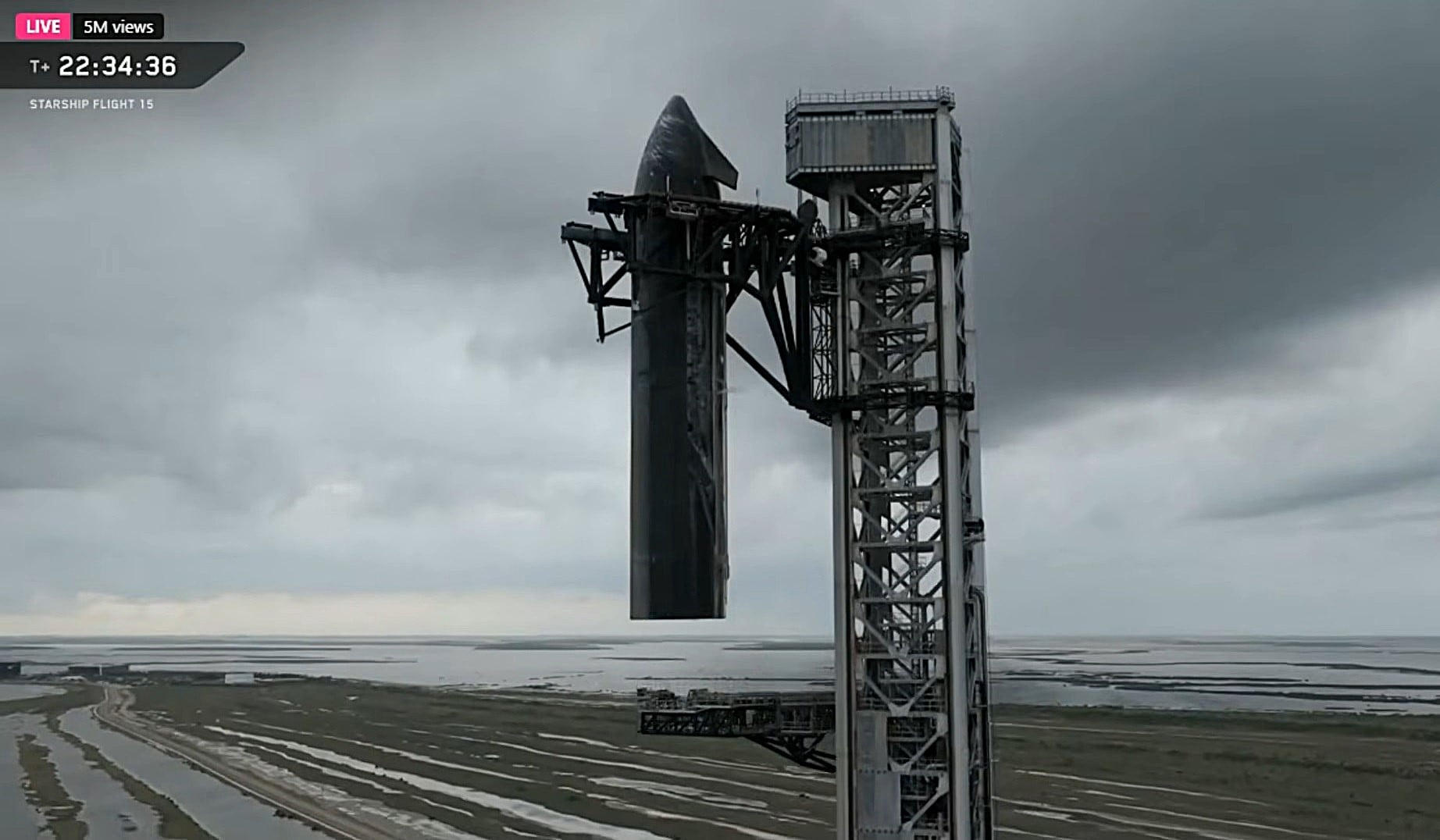
- SpaceX flew the 15th Starship test from Starbase, Texas.
- The upper stage went to orbit, did its job, and came back to the tower.
- The booster did not.
How the views differ
State media, independent media and top voices on X
Breakthrough-focused space coverage and company officials
Supporters treat the catch as the result the program has been building toward.
The ship did not merely hop and fall back.
It reached orbit, stayed up for about a day, released satellites, and was grabbed by the same kind of tower that launched it. They read that as proof the reuse idea can cut cost and speed up flights for Starlink and for NASA’s Artemis lander.
- arstechnica.com (Ind.)
- aljazeera.com (St.)
- thenextweb.com (Ind.)
- thestatesman.com (Ind.)
- dailyfinland.fi (Ind.)
- universetoday.com (Ind.)
- nypost.com (Ind.)
Caution-focused coverage and space analysts
These reports do not deny the catch.
They say a flight that loses half the rocket is only a partial success.
The booster was sent away from the tower and was not brought home, so both stages have still not been recovered together. Until that happens, and until it can be repeated, “fully reusable” describes a goal, not a finished system. Technical trouble stays in the main story.
- pcmag.com (Ind.)
- aljazeera.com (St.)
- satellitetoday.com (Ind.)
- scientificamerican.com (Ind.)
- thenextweb.com (Ind.)
- arstechnica.com (Ind.)
Several independent outlets agree on the event itself, so that part is solid. An orbital upper stage, Ship 42, was caught by the tower after 14 orbits, about 22.5 hours aloft, and the release of 26 Starlink satellites. On the same flight, the Super Heavy booster was not caught. It was diverted and exploded or splashed down in the Gulf of Mexico. Those are reported outcomes, not slogans.
Grey areas. Ask to dive deeper
Grok checks every side again and answers with sources.
Popular questions
Ask anything about this story. It's free with an account, 1 a week.
- October 2023
SpaceX conducts the first integrated Starship flight test from Starbase, Texas.
- March 2025
SpaceX completes the first Super Heavy booster catch by tower arms after a suborbital flight.
Coverage
11 sources · 6 countries
- State-funded 9
- Independent 2
USNLQAINFICA
All sources
- The Next Web / AP (independent)Flight 15 launched from Starbase on November 13/14, 2026. The Next WebState-funded · Netherlands
- Ars Technica (independent)The tower’s mechanical arms caught that upper stage on return, reported as the first catch of an orbital upper stage. Ars TechnicaState-funded
- NY Post (independent)The Super Heavy booster missed its catch, was diverted, and exploded or splashed down in the Gulf of Mexico. NY PostState-funded · United States
- Al Jazeera (independent)SpaceX officials said the catch shows full reusability aimed at rapid, low-cost recycling. Al JazeeraState-funded · Qatar
- The Statesman (local Texas)A Texas local report and a Chinese state report both described the tower catch as a first, matching other outlets on the event. The Statesman Xinhua via Daily FinlandState-funded · India
- Xinhua reporting (state-funded, China) via secondaryA Texas local report and a Chinese state report both described the tower catch as a first, matching other outlets on the event. The Statesman Xinhua via Daily FinlandState-funded · Finland
- universetoday.com“Mechazilla has caught the Starship. We’ve been waiting to hear that for a long time.” — SpaceX commentator Dan Huot, with wording that varies across outlets. Universe TodayIndependent · Canada
- PCMag (independent)The booster catch failed, and that stage was diverted rather than grabbed. PCMagState-funded
- Via Satellite (independent)Coverage still frames both-stage recovery and quick reuse as open technical problems. Via Satellite Scientific AmericanState-funded
- Scientific American (independent)Coverage still frames both-stage recovery and quick reuse as open technical problems. Via Satellite Scientific AmericanState-funded · United States
- Bloomberg (independent)bloomberg.comIndependent · United States