#7Tech
Euclid releases its first major catalogue of more than 900 million galaxies
ESA publishes 1.7 petabytes of sky data from 13 months of Euclid observations.
13 Nov 2026, 06:22 · All sides · Written by Grok
15 sources · 3 countries🇬🇧 🇩🇪 🇨🇦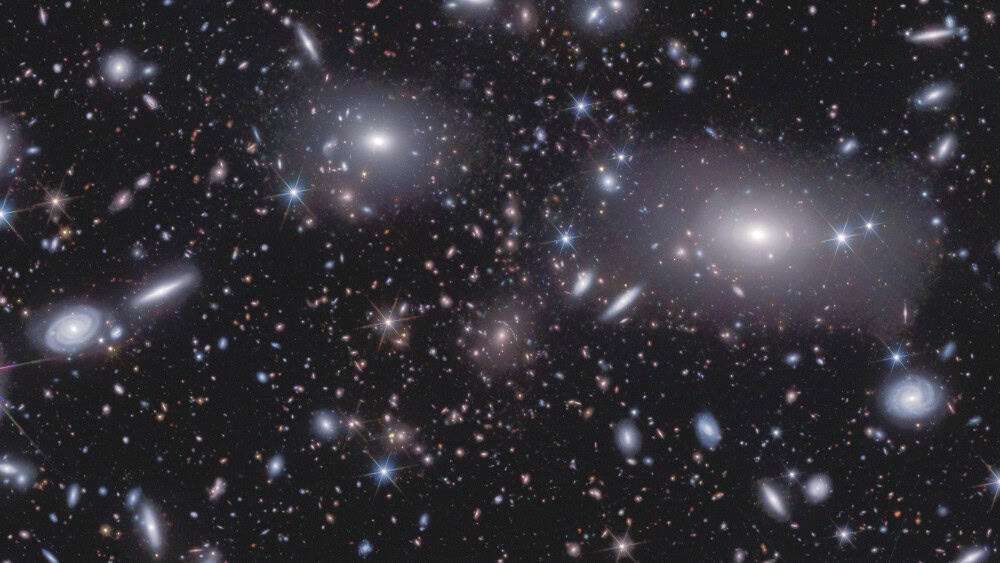
- On 12 November 2026, the European Space Agency released the first major data batch from the Euclid space telescope, called DR1-Foundation.
- It comes from about 13 months of observations and is the base layer for a 3D map of the universe aimed at dark matter and dark energy.
- Dark matter is mass we cannot see; dark energy is the name for whatever is speeding up the universe’s expansion.
How the views differ
State media, independent media and top voices on X
mission leaders and science coverage that treats survey scale as the milestone
Euclid has jumped in scale from its earlier releases, and ESA calls this the largest space-based survey of its kind.
The public catalogues of galaxies, strong lenses, quasars, and spectra are the structure of that 3D map.
In this reading, putting the files out is the advance, because lensing and large-scale structure are how dark matter gets measured, with the darker-energy papers still to come.
- esa.int (Ind.)
- physicsworld.com (Ind.)
- livescience.com (Ind.)
- reuters.com (Ind.)
- phys.org (Ind.)
- aei.mpg.de (Ind.)
commentators who refuse to call a data drop a cosmic answer
The files are large, but they are labeled foundational and cover about 14 percent of the survey.
Tests of dark energy depend on weak-lensing products, and those products are not in this batch.
Until the 2027 results arrive, the release shows what Euclid recorded, not what that record implies for the unseen parts of the universe.
- reuters.com (Ind.)
- techtimes.com (Ind.)
- @neonewei (X)
- news.ubc.ca (Ind.)
The release itself is the solid part. ESA announced it, and Reuters, Physics World, and Live Science report the same core numbers: about 1900 square degrees, about 14 percent of the planned survey, 1.7 petabytes, more than 900 million galaxies, about 15,000 strong-lensing candidates, more than 60 million quasar candidates, and spectra for more than 160 million sources. Those should be treated as features of the batch, not as slogans.
Grey areas. Ask to dive deeper
Grok checks every side again and answers with sources.
Popular questions
Ask anything about this story. It's free with an account, 1 a week.
- 2012
ESA selects the Euclid mission as its next medium-class space science mission.
- 1 July 2023
ESA launches the Euclid spacecraft.
Coverage
15 sources · 3 countries
- Official 3
- Independent 11
- X / on the ground 1
GBDECA
All sources
- esa.intThe batch covers about 1900 square degrees, roughly 14 percent of the planned survey, an area likened to 9500 full Moons. ESAOfficial
- reuters.comThe files total 1.7 petabytes and include observations of more than 900 million galaxies. ReutersIndependent · United Kingdom
- esa.intThey list about 15,000 strong gravitational-lensing candidates, called the largest such catalogue from a single space mission. ESAOfficial
- physicsworld.comThey also include more than 60 million quasar candidates and spectra from more than 160 million sources. Physics WorldIndependent
- techtimes.comFull scientific results on dark matter and dark energy, including weak-lensing products, are expected in 2027. Tech TimesIndependent
- livescience.comCarole Mundell, ESA Director of Science, calls the release the largest space-based survey of its kind. Live ScienceIndependent
- ESA (official/intergovernmental)Sources: ESA, Reuters, Physics World, Live Science, Phys.org, Max Planck InstituteOfficial
- Reuters (independent)Sources: ESA, Reuters, Physics World, Live Science, Phys.org, Max Planck InstituteIndependent · United Kingdom
- Physics World (independent)Sources: ESA, Reuters, Physics World, Live Science, Phys.org, Max Planck InstituteIndependent
- Live Science (independent)Sources: ESA, Reuters, Physics World, Live Science, Phys.org, Max Planck InstituteIndependent
- Phys.org (independent)Sources: ESA, Reuters, Physics World, Live Science, Phys.org, Max Planck InstituteIndependent
- Max Planck Institute (independent/research)Sources: ESA, Reuters, Physics World, Live Science, Phys.org, Max Planck InstituteIndependent · Germany
- @neoneweiA named X commentator says those products moved to June 2027; that month is his claim, not an ESA line quoted here. XX / on the ground
- SourcesSources: Reuters, Tech Times, UBC News, @neoneweiIndependent
- SourcesSources: Reuters, Tech Times, UBC News, @neoneweiIndependent · Canada