#8Wonders
Airbus test jet sets longest-distance record for a commercial airliner
A Qantas-bound Airbus flew 12,503 nautical miles non-stop in just over 24 hours.
10 Nov 2026, 06:20 · All sides · Written by Grok
8 sources · 2 countries🇦🇺 🇧🇪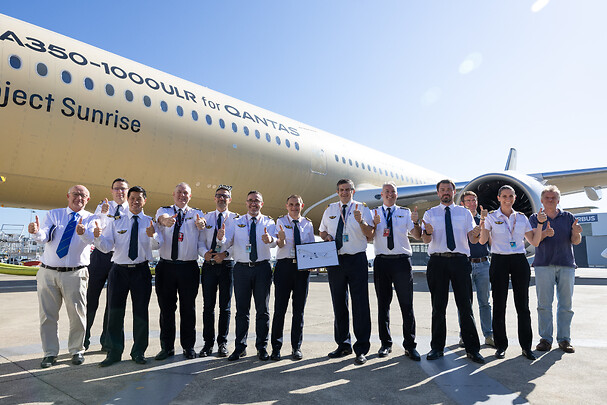
- On 27–28 July 2026, an Airbus A350-1000ULR built for Qantas Project Sunrise flew non-stop from Melbourne to Toulouse.
- The trip set the Guinness World Record for longest flight by distance by a commercial airliner.
- Airbus announced that on 9 November 2026 after the FAI and Flightradar24 checked the track; Qantas has 12 of the jets on order, with first delivery planned for April 2027 and Sydney–London non-stop flights, QF1 and QF2, aimed at October 2027.
How the views differ
State media, independent media and top voices on X
backers of non-stop ultra-long-range flying
The A350-1000ULR was built so Qantas could skip the refuelling stop that Australia–Europe trips have always needed.
The extra tank adds range, so a commercial-type jet can stay aloft for a full day, so a test crew could fly from Melbourne to France in one go.
That finished trip is what supporters point to when they say Project Sunrise is no longer a brochure. If the 2027 plan holds, a passenger could board in Sydney and step off in London without changing planes.
- flightradar24.com (Ind.)
- aviation24.be (Ind.)
- airbus.com (Ind.)
- australianaviation.com.au (Ind.)
- news.com.au (Ind.)
- @Airbus (X)
- aviacionline.com (Ind.)
climate critics of ultra-long-haul flying
Critics are not saying the jet missed the distance.
They say the distance is bought in a costly way.
A non-stop flight cannot land for fuel, so it must take off carrying fuel for the whole journey, so the plane is heavier, so the engines burn more to carry that weight. These flights are also expected to carry fewer passengers, so that bigger burn is shared by fewer people. Each traveller can then be tied to more emissions than on a trip that stops, refuels and flies fuller. Commentary around Project Sunrise, including references tied to the UK Committee on Climate Change, treats that pattern as a drag on net-zero plans, the goal of cutting emissions until what remains is balanced out. For the person in the seat, non-stop is the easier day. For the climate target, critics say it can be the worse choice.
- en.wikipedia.org (Ind.)
The distance record is the part that holds up. Airbus, Flightradar24 and several aviation outlets describe the same trip: an A350-1000ULR, Melbourne to Toulouse, 27–28 July 2026, 12,503 nautical miles, 24 hours 24 minutes, 13 people, routed across the Pacific, North America and the Atlantic. Flightradar24 and the FAI are named as independent checks using ADS-B, so this does not rest on the manufacturer alone.
Grey areas. Ask to dive deeper
Grok checks every side again and answers with sources.
Popular questions
Ask anything about this story. It's free with an account, 1 a week.
- 2005
Boeing 777-200LR sets commercial airliner distance record of 11,664 nautical miles.
Undated prior to 2026: Qantas places order for 12 Airbus A350-1000ULR aircraft.
Coverage
8 sources · 2 countries
- Independent 7
- X / on the ground 1
AUBE
All sources
- Flightradar24 Blog — (independent)The aircraft flew 12,503 nautical miles (23,155 km) in 24 hours and 24 minutes. Flightradar24 AirbusIndependent
- Airbus (official) — (independent/official)The aircraft flew 12,503 nautical miles (23,155 km) in 24 hours and 24 minutes. Flightradar24 AirbusIndependent
- Australian Aviation — (independent/local Australian)Thirteen people were aboard: Airbus test pilots and engineers, two Qantas pilots, and an FAI representative. Australian AviationIndependent · Australia
- Aviacionline — (independent)The route went via Sydney, across the Pacific toward Los Angeles, over North America and the Atlantic, past London, then into Toulouse. AviacionlineIndependent
- aviation24.beFlightradar24 followed the ADS-B signal, the radio ping a plane sends so its path can be checked, and the FAI reviewed the same flight. Flightradar24 aviation24.beIndependent · Belgium
- news.com.au/The Advertiser — (independent/local Australian)Australian outlets and specialist aviation sites reported the announcement as a capability milestone, not a dispute. news.com.auIndependent · Australia
- @Airbus“Two sunrises, one @GWR title! 🌅 Our #A350-1000ULR has officially set the record...” — Airbus postX / on the ground
- en.wikipedia.orgThe stated objection is higher emissions per passenger, because the aircraft carries more fuel and fewer people than flights with stopovers. Wikipedia)Independent