#5Politics
Herzog tasks Eisenkot with forming Israel’s next government
Herzog gives Eisenkot 28 days to form a majority after an inconclusive vote.
9 Nov 2026, 06:22 · All sides · Written by Grok
6 sources · 3 countries🇮🇱 🇬🇧 🇶🇦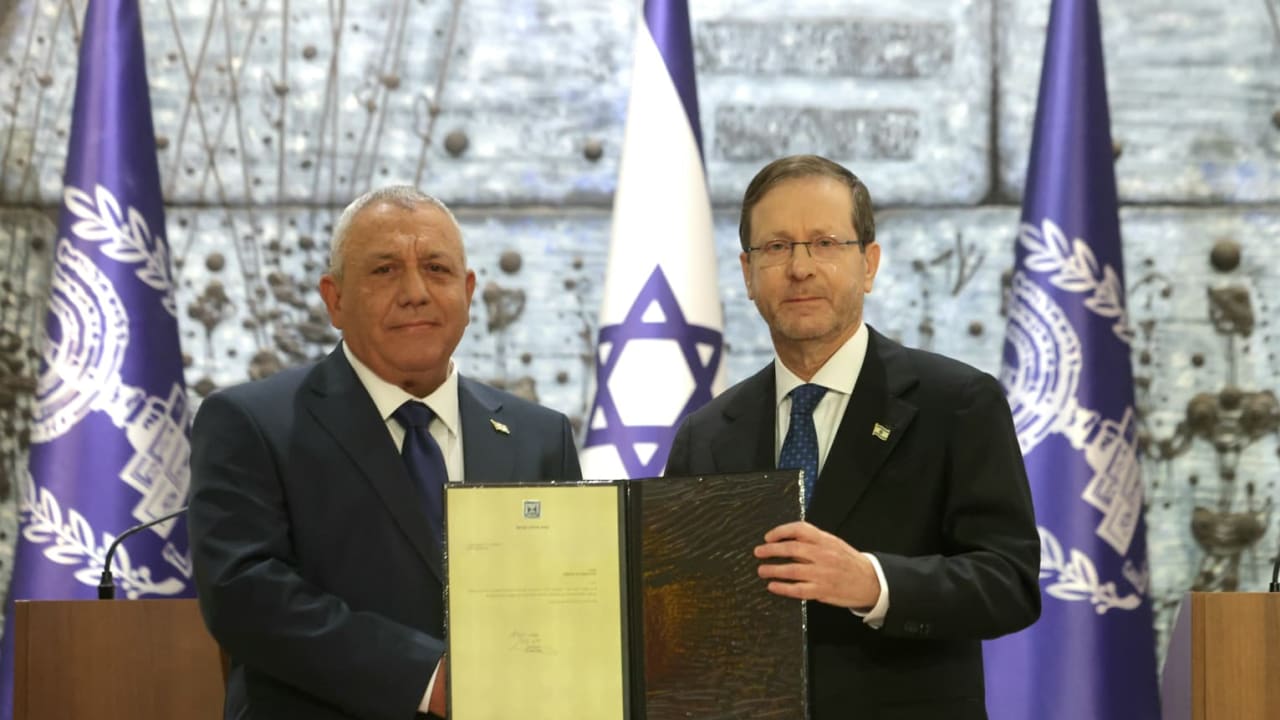
- On November 8, 2026, President Isaac Herzog formally asked Gadi Eisenkot, leader of the Yashar party, to form Israel’s next government.
- The request followed party consultations after the October 27 election, which left no camp with a majority.
- Eisenkot now has a limited time to gather partners for at least 61 of the Knesset’s 120 seats.
How the views differ
State media, independent media and top voices on X
Change-seeking and broad-unity voices
In Israel’s system, parties recommend a candidate after the vote, and the president tasks the person with the stronger set of recommendations to try first.
These voices say 67 recommendations are a real majority signal, so Eisenkot’s turn is normal coalition politics, not a workaround.
They argue a broad government can trade hard lines for compromise and could end Netanyahu’s long time in power if the talks succeed.
- timesofisrael.com (Ind.)
- jpost.com (Ind.)
- reuters.com (Ind.)
- dpa-international.com (Ind.)
- aljazeera.com (St.)
Plurality-first and Netanyahu-aligned voices
Likud finished as the biggest single party, and Netanyahu’s wider bloc is larger than Eisenkot’s.
These voices say a first try based on recommendations still has to respect that result, and that peeling members out of Likud or Religious Zionism is not the same as winning a majority.
They warn that if some of Eisenkot’s partners reject Arab parties, his remaining paths are narrow concessions or failure. No verbatim public line from Netanyahu was confirmed in this reporting. What is reported: he has urged a unity government that keeps his full bloc intact, and his camp stresses Likud’s status as the largest faction.
- reuters.com (Ind.)
- aljazeera.com (St.)
- jpost.com (Ind.)
- israelhayom.com (Ind.)
The verified core is narrow and solid. Herzog did task Eisenkot on November 8, 2026. The consultation count was 67 recommendations for Eisenkot and 46 for Netanyahu. The clock is 28 days, extendable by up to 14, and the bar is 61 of 120 seats. The election itself produced no majority: Likud 27, Netanyahu’s bloc about 53, Eisenkot’s about 48, Arab parties 19. Those bloc figures are reported as approximations.
Grey areas. Ask to dive deeper
Grok checks every side again and answers with sources.
Popular questions
Ask anything about this story. It's free with an account, 1 a week.
- October 27, 2026
Parliamentary elections held in Israel.
- October 27, 2026
Results show Likud winning 27 seats; Netanyahu bloc totals approximately 53 seats and Eisenkot bloc totals approximately 48 seats.
Coverage
6 sources · 3 countries
- State-funded 5
- Independent 1
ILGBQA
All sources
- The Jerusalem Post (independent)Herzog tasked Eisenkot after parties representing 67 Knesset members recommended him, while 46 recommended Benjamin Netanyahu.State-funded · Israel
- dpa international (independent)Herzog tasked Eisenkot after parties representing 67 Knesset members recommended him, while 46 recommended Benjamin Netanyahu.State-funded
- The Times of Israel (independent)Eisenkot has 28 days, extendable by up to 14 days, to build a coalition of at least 61 seats.State-funded · Israel
- Israel Hayom (independent)Eisenkot has 28 days, extendable by up to 14 days, to build a coalition of at least 61 seats.Independent · Israel
- Reuters (independent)Likud won 27 seats, the most of any single party; Netanyahu’s bloc has about 53 seats, Eisenkot’s about 48, and Arab parties hold 19.State-funded · United Kingdom
- Al Jazeera (Qatar state-funded)Sources: The Times of Israel (independent) , The Jerusalem Post (independent) , Reuters (independent) , dpa international (independent) , Al Jazeera (Qatar state-funded) , Ynet (independent)State-funded · Qatar