#2Politics
2026 Midterms Put Control of Congress on the Line
Republicans defend narrow majorities while final polls favor Democratic gains in Congress.
3 Nov 2026, 06:21 · All sides · Written by Grok
15 sources · 3 countries🇬🇧 🇺🇸 🇶🇦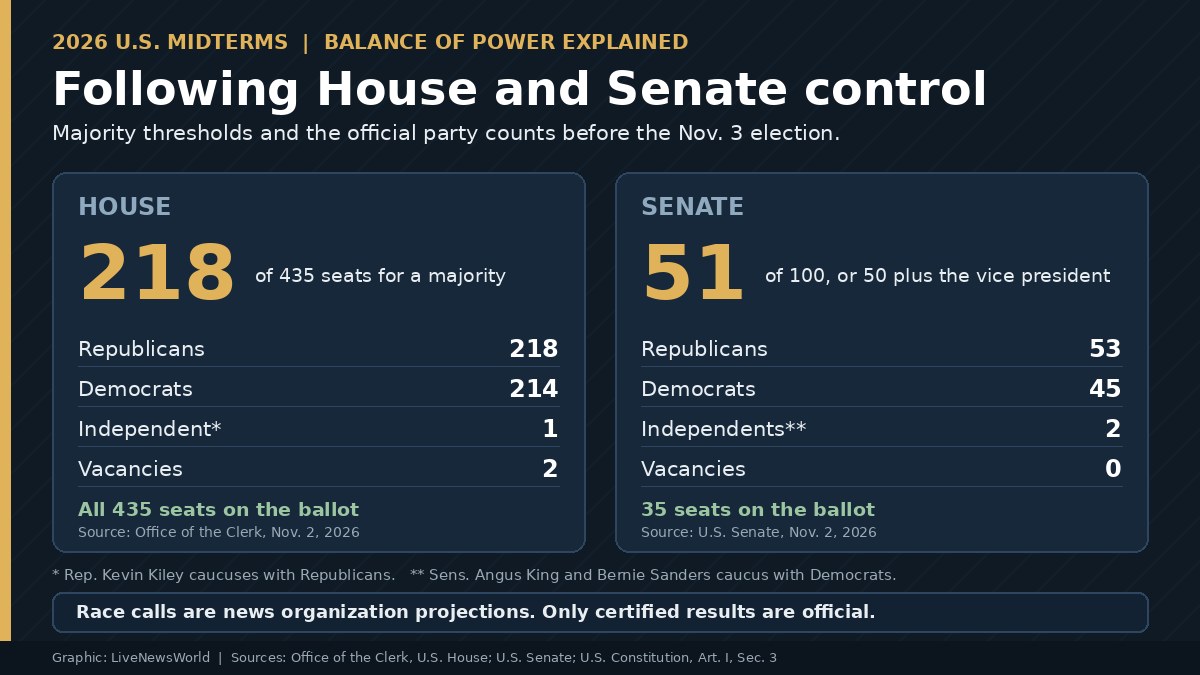
- A midterm is the national vote halfway through a president’s term, when the presidency itself is not on the ballot.
- On November 3, 2026, Republicans enter that vote with thin majorities, and the elections are widely described as a referendum on President Donald Trump’s second term, with the cost of living and the US-Iran conflict among the issues cited.
- 34
How the views differ
Republican officials and Trump supporters
Republicans and Trump supporters treat the midterms as a fight to protect what they see as the achievements of his second term.
They are telling supporters to vote as if Trump’s name were on the ballot, and they are warning that Democratic candidates are extreme.
They also say history usually hurts the president’s party at midterms, but that Republicans still ran a serious campaign and would keep a veto and some continuity even if they lose seats.
- cnbc.com (Ind.)
- reuters.com (Ind.)
- foxnews.com (Ind.)
- aljazeera.com (St.)
Democratic campaigns and aligned analysts
Democrats and analysts aligned with them describe the midterms as a public limit on Trump after frustration over prices and the US-Iran conflict.
They point to polls showing Democratic momentum, including in some states Trump won, and they say a new majority could open investigations.
The path they highlight is narrow but real: small net gains would be enough to overturn both Republican majorities. Democrats “need a net gain of four seats in both the US House of Representatives and US Senate to overturn Republicans’ narrow 218-214 and 53-47 majorities.” — Reuters, Nov. 2–3, 2026 [[3]].
- reuters.com (Ind.)
- nytimes.com (Ind.)
- bbc.com (St.)
- theguardian.com (Ind.)
- axios.com (Ind.)
The chamber math is solid: Republicans start the day ahead by a few seats, Democrats need only a small net gain for a majority, and every House seat plus 35 Senate seats are being decided. One Reuters line rounds the House need to four seats; the working figure in the same reporting is about 3-4 House seats and 4 Senate seats, which fits a count that includes vacancies and an independent. [[1]](www.
Grey areas. Ask to dive deeper
Grok checks every side again and answers with sources.
Popular questions
Ask anything about this story. It's free with an account, 1 a week.
- November 5, 2024
Donald Trump wins the 2024 U.S. presidential election.
- November 2024
Republicans secure 218-214 majority in the House and 53-47 majority in the Senate.
Coverage
15 sources · 3 countries
- State-funded 9
- Independent 6
GBUSQA
All sources
- All 435 House seats and 35 Senate seats are on the ballot.A midterm is the national vote halfway through a president’s term, when the presidency itself is not on the ballot. On November 3, 2026, Republicans enter that vote with thin majorities, and the elections are widely described as a referendum on President Donald Trump’s second term, with the cost of living and the US-Iran conflict among the issues cited.State-funded · United Kingdom
- Reuters (independent)A midterm is the national vote halfway through a president’s term, when the presidency itself is not on the ballot. On November 3, 2026, Republicans enter that vote with thin majorities, and the elections are widely described as a referendum on President Donald Trump’s second term, with the cost of living and the US-Iran conflict among the issues cited.State-funded · United Kingdom
- livenewsworld.comRepublicans hold about 218-214 in the House, with one independent caucusing with them and some seats vacant, and 53-47 in the Senate, including two independents who caucus with Democrats.Independent
- congresscountdown.comRepublicans hold about 218-214 in the House, with one independent caucusing with them and some seats vacant, and 53-47 in the Senate, including two independents who caucus with Democrats.Independent
- NYT (independent)NYT/Siena, Sabato’s Crystal Ball, and Kalshi markets favor Democrats to win the House and give them a strong chance or an edge in the Senate.State-funded · United States
- centerforpolitics.orgNYT/Siena, Sabato’s Crystal Ball, and Kalshi markets favor Democrats to win the House and give them a strong chance or an edge in the Senate.Independent · United States
- axios.comNYT/Siena, Sabato’s Crystal Ball, and Kalshi markets favor Democrats to win the House and give them a strong chance or an edge in the Senate.State-funded · United States
- reuters.comMore than 57 million early ballots had been cast by November 2.Independent · United Kingdom
- cnbc.com“For some reason, the sitting president doesn’t win the midterms. But we gave this a very strong shot.” — Donald Trump, Nov. 2, 2026, Lincoln Memorial Reflecting PoolState-funded · United States
- foxnews.comSources: Reuters (independent) ; Fox News (independent) ; Al Jazeera (Qatar state-influenced) ; CNBCState-funded · United States
- Al Jazeera (Qatar state-influenced)Sources: Reuters (independent) ; Fox News (independent) ; Al Jazeera (Qatar state-influenced) ; CNBCState-funded · Qatar
- BBC (UK public broadcaster)Sources: Reuters (independent) ; NYT (independent) ; BBC (UK public broadcaster) ; The Guardian (independent) ; Axios (independent)State-funded · United Kingdom
- theguardian.comSources: Reuters (independent) ; NYT (independent) ; BBC (UK public broadcaster) ; The Guardian (independent) ; Axios (independent)State-funded · United Kingdom
- The Telegraph (independent)telegraph.co.ukIndependent · United Kingdom
- Ballotpedia (independent/nonpartisan)ballotpedia.orgIndependent